1000 days of genocide in Gaza: Shocking figures of ongoing agony
The Gaza Strip remains a living, bleeding chapter in modern history, one that will never be forgotten. It stands as one of the largest humanitarian catastrophes of the modern era.
By Yasmine Osama Farag
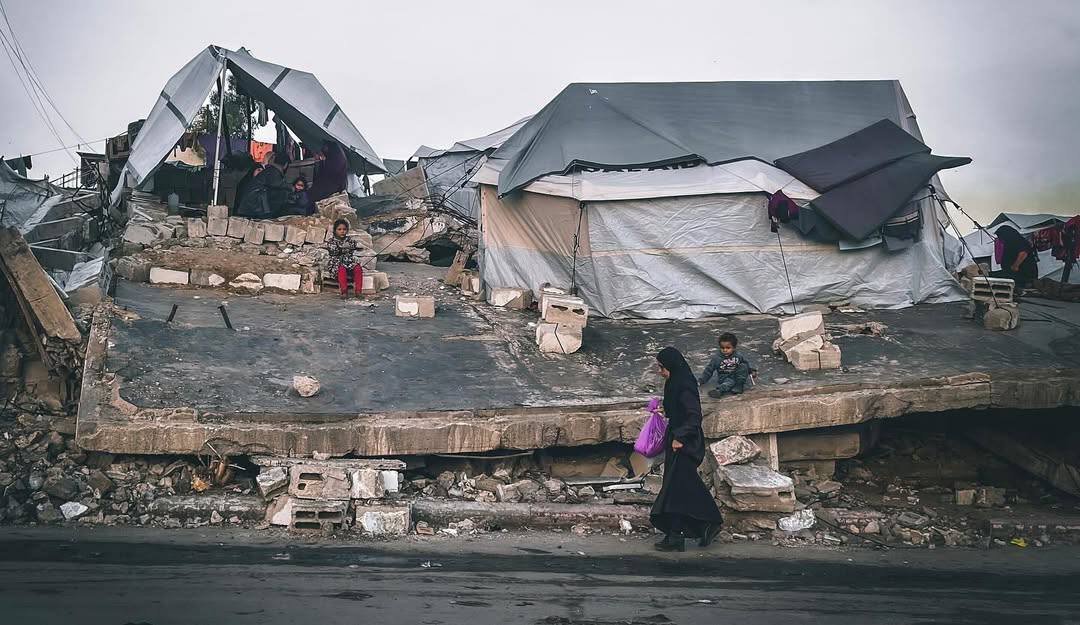
The catastrophic effects of Israel’s relentless bombardment, suffocating siege, and systematic starvation have penetrated every single aspect of life in the Palestinian strip. This onslaught has left tens of thousands of victims killed or maimed and caused widespread destruction to infrastructure and vital service sectors. Compounding this horror, ongoing Israeli violations of the October ceasefire continue to deepen the profound humanitarian suffering of the strip’s population.
Human toll and infrastructure devastation
The Government Media Office in Gaza released a harrowing statement on Thursday, announcing that since the outbreak of Israel’s genocidal war on the strip 1,000 days ago, the Israeli occupation army has killed at least 73,066 Palestinian martyrs. The number of injured has surged to more than 173,514 people.
The statement emphasized that women and children constitute the vast majority of the victims, with more than 21,500 children and 12,500 women documented among the dead. Furthermore, 2,700 entire families have been completely erased from the civil registry.
The tragedy extends far beyond the known casualties. The Al-Dameer Association for Human Rights has documented over 9,500 missing persons, including approximately 4,700 women and children, marking one of the most painful and unresolved grievances of this war.
According to Palestinian data, the ongoing assault has also left behind more than 47,000 widows and over 58,000 children who have lost one or both parents.
Join Our WhatsApp Channel for Updates and Announcements
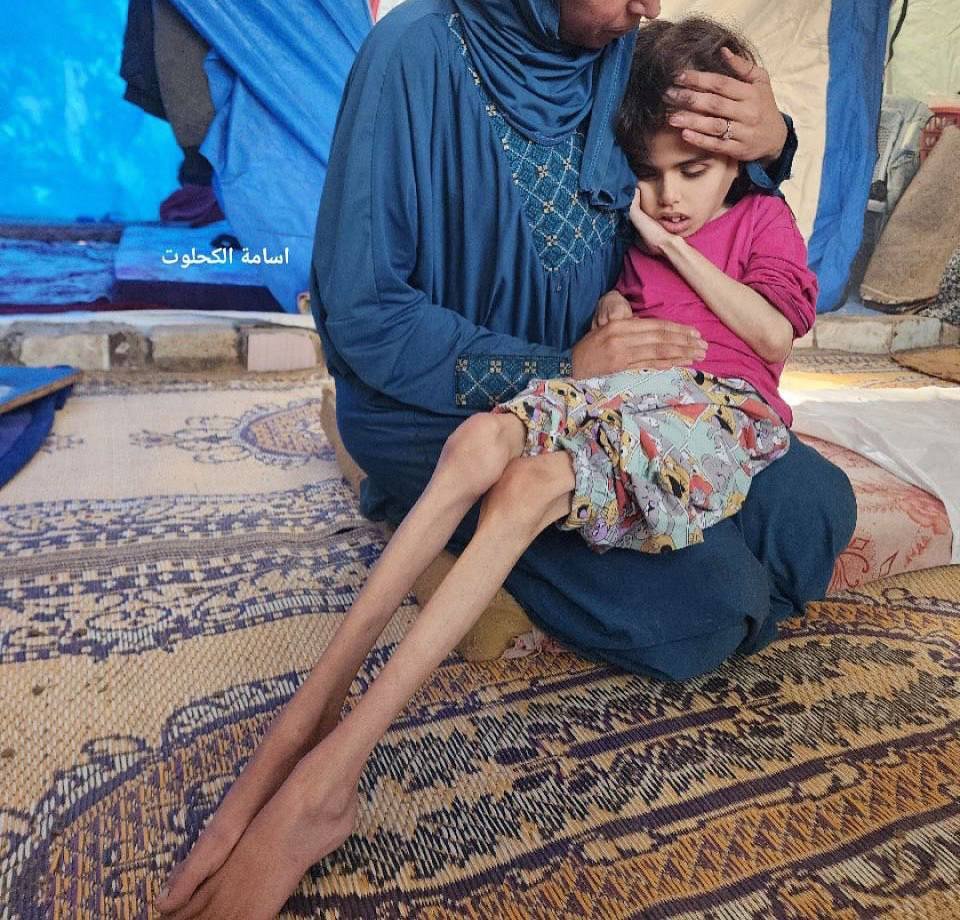
A child in Gaza shows her frail body due to starvation, while many other children suffer the same plight as a result of the ongoing siege.
The Media Office explained that Israeli military forces have rained down more than 223,000 tonnes of explosives on the captive population.
This unprecedented firepower has destroyed over 90 percent of Gaza's infrastructure, systematically targeting residential neighborhoods and vital public facilities.
The official statement confirmed that the destruction has laid waste to more than 410,000 housing units, decimated thousands of kilometers of electrical grids, and knocked out 97 percent of the safe drinking water supply. The agricultural sector has been devastated, shrinking by 87 percent, culminating in direct economic losses exceeding $80 billion.
On the economic front, 88 percent of industrial and commercial establishments have been damaged or outright destroyed. This targeted economic collapse has driven unemployment rates to an astronomical 80 percent amid a standstill of production lines.
The destruction of houses of worship
In the Gaza Strip, the historic calls to prayer from mosques and the ringing of church bells have been silenced under mounds of rubble. Israeli airstrikes have consistently targeted places of worship as part of the broader campaign of erasure.
According to the Ministry of Endowments and Religious Affairs in Gaza, occupation forces have completely destroyed 1,050 mosques and partially damaged 191 others, out of the 1,275 mosques that stood before the war.
Churches were not spared from this cultural and religious cleansing. In Gaza City, where the Kateb al-Wilaya Mosque and the Church of Saint Porphyrius have shared a neighboring wall for centuries, Israeli bombardment struck both. These attacks targeted religious landmarks that, regardless of faith, formed the spiritual and historical memory of the city.
Three historic churches were heavily hit.
The first was the Holy Family Church. Located in eastern Gaza City, this sanctuary was bombed multiple times during the war, resulting in numerous civilian casualties who were seeking shelter.
The Church of Saint Porphyrius came next. Dating back to the 5th century AD and located in the Al-Zaytoun neighbourhood, it is one of the oldest active churches in the world. It was severely damaged by direct Israeli strikes.
The third was the Baptist (Al-Ahli) Church. Affiliated with the Anglican Episcopal Church in Jerusalem and founded in 1882 by an English missionary mission, its name became forever tied to one of the war's most horrific atrocities. On October 17, 2023, Israeli forces struck the courtyard of the Al-Ahli Arab Baptist Hospital, slaughtering nearly 500 Palestinians seeking refuge.
A collapsed healthcare sector
The Government Media Office highlighted a near-total collapse of Gaza's healthcare network.
Due to direct bombardment, 38 hospitals have been forced completely out of service, while at least 94 percent of the strip's medical facilities have sustained varying degrees of damage.
Related
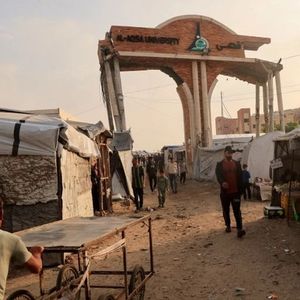
Nearly 1,700 medical workers have been martyred while trying to save lives. Meanwhile, more than 173,000 wounded people face acute shortages of medicine, and 22,000 critical patients are being blocked by occupation authorities from leaving the strip to receive life-saving treatment abroad. This healthcare vacuum coincides with a catastrophic spread of infectious diseases among displaced families.
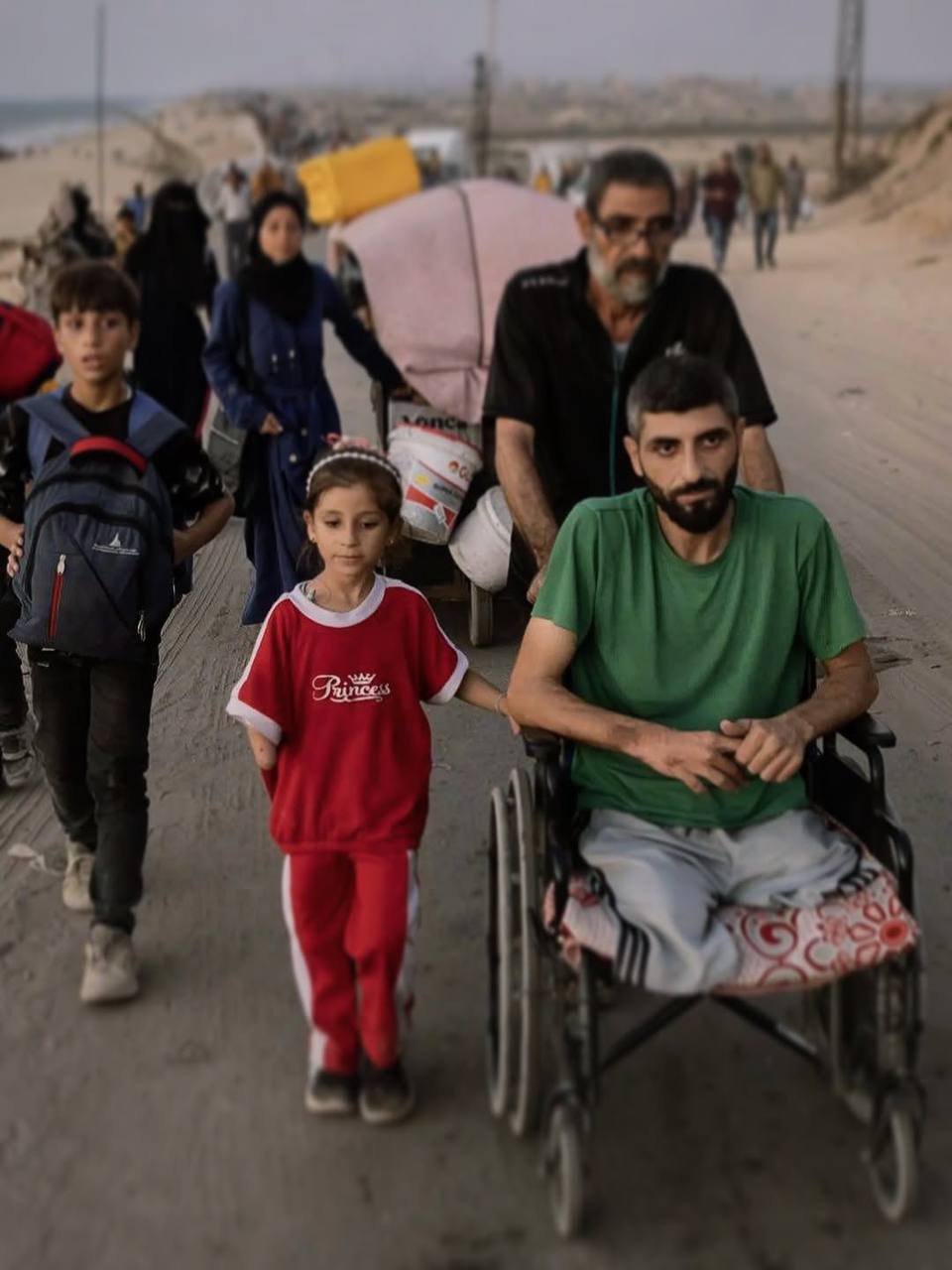
Gaza's pain in one frame: a father with no legs, a daughter with one arm... countless families shattered, countless children left without parents.
The United Nations (UN) has registered approximately 5,000 cases of amputations. The Ministry of Health continues to warn of an absolute collapse, noting that shortages of basic medical supplies and laboratory testing materials have reached a critical 87 percent.
The World Health Organization (WHO) has documented hundreds of distinct attacks on healthcare infrastructure since the war began. It warned that ongoing military maneuvers and forced evacuation orders threaten to push the remaining skeletal hospital staff completely out of commission. WHO data show that the number of available hospital beds has shrunk drastically relative to skyrocketing medical needs.
Endless displacement
According to the United Nations Office for the Coordination of Humanitarian Affairs (OCHA), approximately 1.9 million Palestinians remain displaced, representing nearly 90 percent of the Gaza Strip's entire population.
UN data indicates that many of these families have been forced to flee multiple times, pushed from one devastated zone to another by expanding military operations and draconian Israeli evacuation orders.
Sigrid Kaag, the UN Senior Humanitarian and Reconstruction Coordinator for Gaza, confirmed that more than one million people have been uprooted repeatedly during different phases of the war in a desperate, futile search for safety. OCHA documented the absolute destruction of over 320,000 homes, forcing the displaced to survive in squalid, unlivable conditions completely deprived of basic human necessities.
Malnutrition and the annihilation of agricultural land
The prolonged, deliberate closure of border crossings by Israeli forces has triggered an unprecedented food crisis. By choking off the flow of aid, the blockade has placed 650,000 children at imminent risk of starvation and acute malnutrition.
Palestinian data reveals that 98.5 percent of Gaza's agricultural land has been destroyed. This aligns with a study by Mercy Corps, which concluded that 96 percent of agricultural terrain has been systematically bulldozed, contaminated, or rendered completely inaccessible due to military operations.
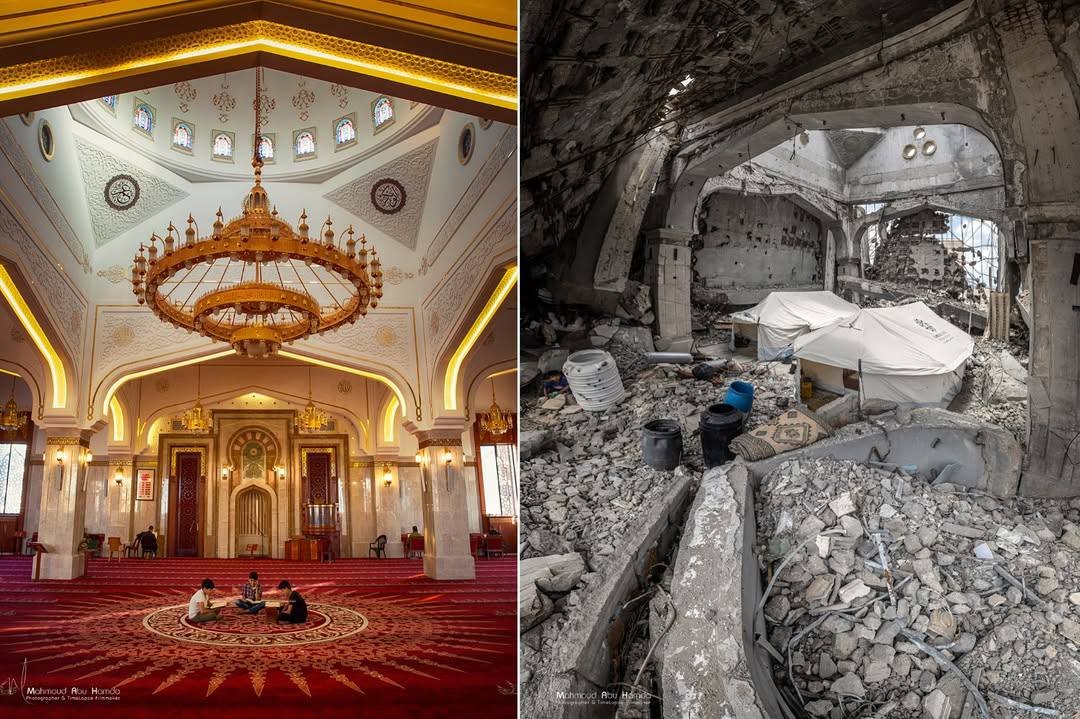
On the left, the mosque in Gaza's port appears in all its splendor. On the right, the same scene after it was struck by the Israeli machinery of war
The UN Relief and Works Agency for Palestine Refugees (UNRWA) warned that the food crisis is deteriorating rapidly despite a trickling, highly restricted influx of aid. The vast majority of Gaza's residents now rely entirely on charity kitchens and meager humanitarian handouts, as markets, commercial bakeries, and farms have been completely erased.
Education denied: Destruction and deprivation
Gaza's educational ecosystem has been completely dismantled. The Government Media Office stated that every single school in the strip has been impacted, including 284 schools that have been entirely destroyed.
This systematic destruction has stripped more than 620,000 school-aged children of their right to education, while the academic journeys of 88,000 university students have been entirely halted. Palestinian statistics reveal that more than 20,000 students have been killed in the onslaught.
Hundreds of thousands of students are being denied education for the third consecutive school year, marking one of the longest continuous educational disruptions in modern history.
UN agencies warn of the permanent loss of academic years for an entire generation of Palestinian youth. Furthermore, the vast majority of surviving schools have been converted into overcrowded shelters for the displaced, making any immediate resumption of formal education nearly impossible, even in areas where active ground maneuvers have subsided.
A cry for global action
In its closing remarks, the Government Media Office in Gaza issued an urgent plea to the international community and UN bodies. It demanded immediate, binding action to halt Israeli military operations, open all border crossings, and guarantee the unrestricted entry of humanitarian and medical aid. The office held Israel and its western backers legally and morally responsible for these historic violations.
The statement called for an immediate, unified Arab and Islamic intervention to rescue the strip and implement a comprehensive reconstruction blueprint. It stressed that Israel’s policies of destruction will never succeed in forcing a permanent reality of displacement on the Palestinian people.
Concurrently, Palestinian resistance factions marked the 1,000-day threshold of the genocidal war by calling for intensified resistance and steadfast national unity. In a joint statement, the factions described the situation as an "unrelenting war," noting that despite Israel's use of overwhelming military power, the occupation has "failed to achieve its declared objectives," including its primary goals of ethnically cleansing the population or enforcing a new political reality on the ground.
The factions emphasized that the current confrontation is a continuation of the struggle against Israeli policies dating back to 1948, framing the resistance as a direct response to ongoing settlement expansion, the siege of Gaza, and aggression in the West Bank and Jerusalem.
The statement firmly rejected "any external guardianship" over the future of the Gaza Strip, asserting that the administration of Gaza remains an exclusively internal Palestinian matter. To that end, they called for the urgent formation of a technocratic committee to manage Gaza's immediate affairs, alongside the launching of a comprehensive national dialogue to unite all Palestinian factions and rebuild national institutions. (Al Ahram)