
Protests over directive to Kadhi’s Courts to stop issuing divorce certificates
Instead, new provisions are now being introduced into the Islamic divorce process where the Kadhis courts are now being directed to adopt, “Decree Nisi and Decree Absolute” as proof of dissolution of marriage.
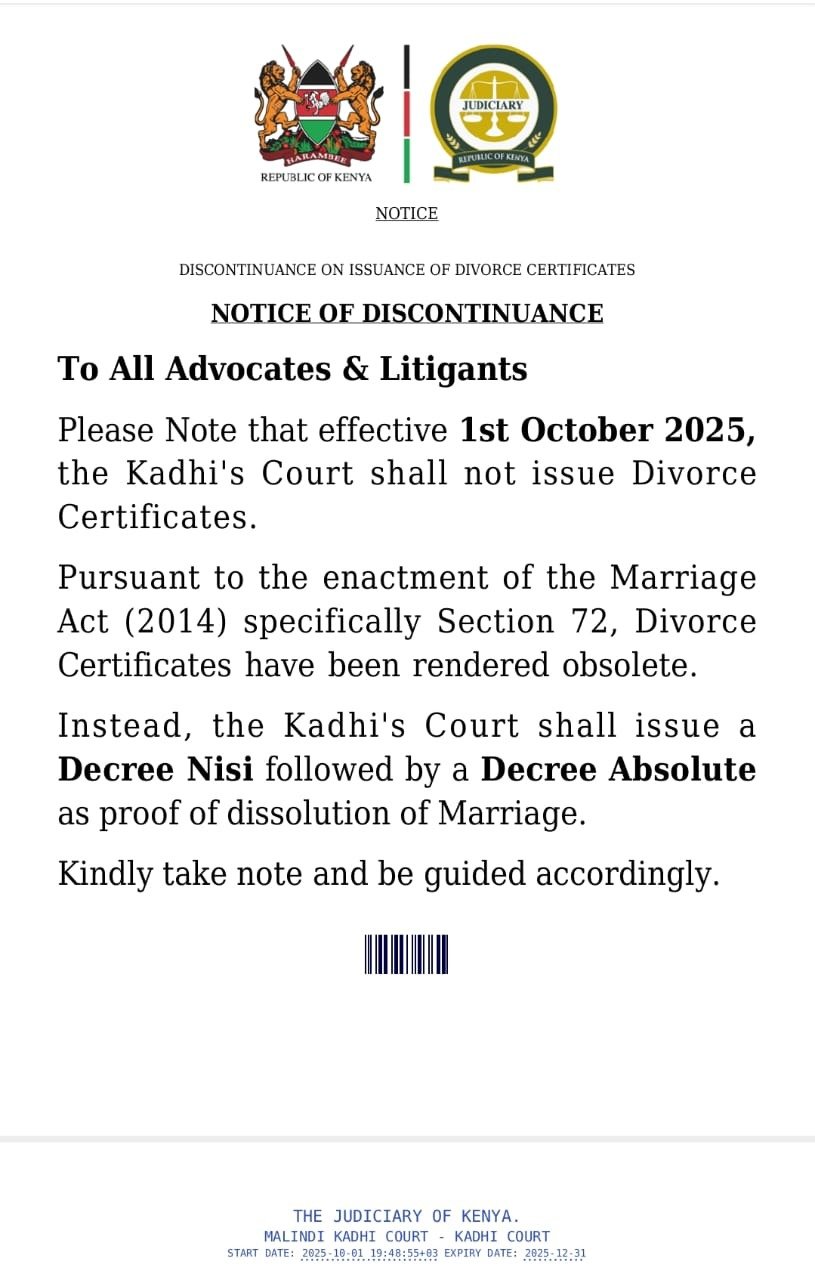
The Judiciary has issued a directive that Kadhi’s courts will no longer be issuing divorce certificates after dissolution of marriages.
Instead, new provisions are now being introduced into the Islamic divorce process where the Kadhi's Courts are now being directed to adopt, “Decree Nisi and Decree Absolute” as proof of dissolution of marriage.
“Please note that effective 1st October 2025, the Kadhi’s courts shall not issue divorce certificates. Instead, the Kadhi’s Courts shall issue a Decree Nisi followed by Decree Absolute as proof of marriage,” read the notice addressed to advocates and litigants. The notice also indicated that divorce certificates “have been rendered obsolete.”
A Decree Nisi is a provisional divorce order issued by the court, acknowledging the breakdown of the marriage but without dissolving it. The temporary order runs for 30 days and gives the parties time to make a final decision on whether they still wish to proceed with the divorce and have the marriage dissolved. If no objections are raised within this period, a Decree Absolute is issued, which dissolves the marriage and allows the parties to remarry.
Decree Nisi and Decree Absolute are the main features in the dissolution of marriages conducted under Civil and Christian marriage regulations.
Contacted for comment, the acting Chief Kadhi Sheikh Sukyan Omar Hassan said he was yet to receive official communication on the implementation of the new regulations.
Other Kadhis who spoke to Sahifa.co.ke on condition of anonymity, as they were not authorized to comment on judiciary matters, however, faulted the directive, saying it was not done with consultations of Kadhis and the Muslim community, who are the main stakeholders.
“The issues of divorce are well documented in the Kadhis’ Courts rules and procedures legal framework of 2020, which covers various divorce aspects such as talaq, khul, and lian. Why are they introducing new rules that are inconsistent with Islamic practices?” he wondered.
“In Islam we have revocable and irrevocable divorces, but these new procedures, which are borrowed from English law, have no Islamic basis. This is unacceptable,” he said.
Another Kadhi, who also requested anonymity, was unequivocal that the Marriage Act recognizes marriage practices—civil, Christian, Muslim, Hindu and customary—and each has its own set of laws, which have to be respected. “Decree Nissi and Decree Absolute are derived from English canon laws, they are not part of the Islamic divorce practices,” he said.
He read a sinister agenda in the directive saying that this started with the order that excluded marriage registrars from issuing divorce certificates and left the matter to the Kadhi courts.
“Now they are also prohibiting the courts from issuing divorce certificates. As Muslims, we need to raise our voices loudly on this matter. These are insidious plans to weaken the Kadhis courts. Its functions are clear, and all along the courts have been issuing divorce certificates,” the Kadhi added.
Nairobi-based advocate Prof. Hassan Nandwa also read mischief in the new directives, saying that they were inconsistent with Islamic law. “This is a misplacement. We have our own divorce system; why are they bringing new features into Muslim law?” he questioned.
“This is how they are weakening the Kadhi's Courts, next they will say the courts have no jurisdiction to handle issues concerning polygamy. Muslim lawyers and leaders have to come in and urgently address this matter,” he added.
A lecturer at the University of Nairobi, Dr. Abdulkadir Hashim, described the directive to introduce Decree Nisi and Decree Absolute into the Kadhi’s Court functions as “strange.” He emphasized that the laws governing the process of divorce in Islamic law were clear and there is no relevance to introduce new laws borrowed from other groups.
According to the Marriage (Matrimonial Proceedings) Rules (Legal Notice 122 of 2020), dissolution of a marriage celebrated under Islamic law shall be governed by the Kadhi's Court in accordance with its rules and procedures.
In the rules pertaining to the dissolution of Islamic marriages as stipulated in the Kadhis' Courts (Procedure and Practice) Rules Legal Notice 203 of 2020, there is no mention of Decree Nissi and Decree Absolute.