
The Borrowed Tongue: When Muslims Speak the Language of Their Oppressors.
Since the onset of the Gaza war, a set of arguments has circulated among some Muslims, arguments that, perhaps unknowingly, align perfectly with the narratives crafted by Zionist strategists and secular policymakers. They
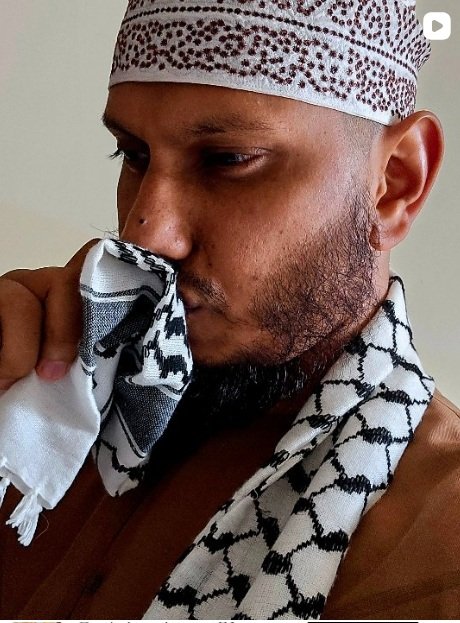
By Imam Abdurrahman Ishaq
In times of crisis, the most dangerous ideas are not always those that come from our enemies but those that are echoed by our own, draped in the language of pragmatism and peace.
Since the onset of the Gaza war, which has tragically unfolded into a full-scale genocide, a set of arguments has circulated among some Muslims, arguments that, perhaps unknowingly, align perfectly with the narratives crafted by Zionist strategists and secular policymakers. They repeat, almost verbatim, the very talking points through which our adversaries maintain control over Muslim thought and paralyze our collective resolve.
These claims often take the following forms. For the sake of simplicity, this article will focus on the three most common ones, and I will provide a direct, bold, and unapologetic response to each, in light of the Quran and Sunnah.
1. “Palestinians shouldn’t engage in resisting by fighting; we are not well equipped to do so as the enemy is much stronger.”
2. “If we do, generations will be wiped out and more land will be lost.”
3. “Palestine should always settle with a treaty, just as the Prophet ﷺ signed the Treaty of Hudaybiyya.”
At first glance, these points appear rational, even compassionate. But when weighed against the Qur’an, Sunnah, and the logic of history, they fall apart completely. They do not represent Prophetic wisdom, they represent a colonized mindset, one that waters down Islam’s moral strength,appeases the zionists and conditions Muslims to accept humiliation as realism.
1. The Myth of “We Are Too Weak”
The claim that Muslims should not resist because they are ill-equipped is a betrayal of faith and history alike.
This line of reasoning would nullify hundreds of Qur’anic verses on jihad and resistance, rendering divine guidance “contextual” and “inapplicable.” Yet the Qur’an itself answers this false logic:
“How many times has a small force vanquished a mighty army by the Will of Allah! And Allah is ˹always˺ with the steadfast.” (Surah al-Baqarah 2:249)
No Prophet, no Companion, and no scholar in our history ever claimed that resistance becomes invalid simply because the enemy is stronger. If that were true, how do we explain Badr, where 313 believers stood against 1,000? Or Uhud, Khandaq, Yarmouk, and Hattin, where Muslims fought against overwhelming odds?
Not once did the Prophet ﷺ suspend jihad until conditions were “ideal.” To suggest otherwise implies that he erred and that Allah’s promise of help to the oppressed was conditional on material superiority.
In truth, every major victory in Islamic history was won not through numbers or arms, but through faith, conviction, and courage. To make power a precondition for resistance is to reduce faith to mere strategy and to replace tawakkul (trust in Allah) with fear of failure.
As for the second hollow claim — one rooted in false compassion — it goes as follows:
2. “War only brings about destruction more Muslim lands are lost and generations are wiped out”
This argument, too, is morally inconsistent and religiously hollow.
If concern for future generations is genuine, then one must respect - not condemn - those who resist so that these generations may live with dignity.
The tragic irony is that those who speak of “saving lives” often turn a blind eye to the slaughter of innocents by the very oppressor they fear to confront. The enemy has been wiping out generations with or without resistance. Submission has never preserved life; it has only emboldened tyranny.
Moreover, it is not “generations” that are being wiped out, it is honour that is being revived, and martyrdom that is being written in the pages of history. Every fallen soul in defense of truth dies not in vain but with eternal purpose.
As for the lands lost, the Qur’an speaks louder than my words, in the opening verses of Surah al-Qasas when Allah makes His promise explicit: “But it was Our Will to favour those who were oppressed in the land, making them models ˹of faith˺ as well as successors.” ( Surah Al-Qasas 28:5)
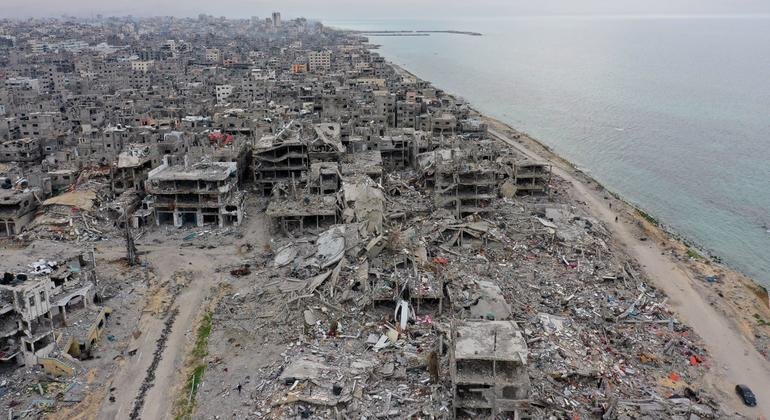
The unimaginable and systematic destruction of Gaza by the Israeli genocidal regime
Allah’s promise is clear the land will always return to the oppressed, not to the compliant.
And if weakness is the excuse, then where are the neighboring Muslim nations the ones with armies, wealth, and proximity? Are they weak too? Or are they guilty of the greater sin of abandoning the oppressed, an act that brings upon the very disgrace the Prophet ﷺ warned of when the Ummah would forsake jihad and chase the dunya?
3. The “Hudaybiyya Card” (A Convenient Red Herring)
No doubt, having treaties with enemies can at times be beneficial, and Islam indeed makes room for such agreements, however the perception of treaties being advocated for in this context suggests that Palestinians should commit to permanent peace agreements with the Zionist entity, even when history has repeatedly shown such arrangements to be futile. This narrative implicitly demands that the Palestinians continue to endure oppression, regardless of its severity or inhumanity.
Such a viewpoint is one that the ordinary Gazan, who has endured unimaginable suffering for decades, will not appreciate and cannot possibly be expected to accept. After decades of shattered agreements, unkept promises, and escalating brutality, it is only natural that these constant appeals for restraint and compromise — conveniently cloaked in misapplied references to the Treaty of Hudaybiyyah — ring hollow. To demand endless patience from a people living under relentless siege and occupation is not a call for peace; it is a call for submission to injustice.
Hudaybiyya was not a theology of surrender; it was a temporary truce, a strategic pause within a continuous struggle. The same Prophet ﷺ who signed that treaty also fought Badr, Uhud, Khaybar, Hunayn, and ultimately marched into Makkah in victory.
To reduce his entire mission to one treaty while ignoring his life of courage and confrontation is to insult his legacy and distort his example. This selective reading is a form of religious revisionism, a way to neutralize Islam’s strength by stripping it of its will to ACT.
It turns Islam into a mere ritual, a private spirituality divorced from the realities of justice, oppression, and power, precisely the version of Islam our enemies are most comfortable with.
Let it be clear….
Islam is neither reckless nor pacifist; it calls for measured courage guided by revelation. To be strategic is part of wisdom, but to hide cowardice behind strategy is deception.
The Qur’an commands both hikmah (wisdom) and ‘Izzah (dignity). A believer’s duty is not to calculate defeat before the battle begins, but to act upon principle, leaving outcomes to Allah.
Abandoning divine imperatives in the name of pragmatism is not intelligence, it is faithlessness disguised as maturity.
Our true crisis is not lack of power but lack of conviction. We have internalized the rhetoric of our adversaries, cautioning against “extremism,” redefining resistance as “terror,” (armed resistance for Gazans is actually justified under international law let alone Islam) and labeling faith-driven action as “emotion.”
But when upholding faith becomes ‘emotion’ and submission to injustice becomes wisdom, then Islam itself has been domesticated.
It is time to draw a clear line between divine guidance and secular conditioning. Our Prophet ﷺ taught us that dignity is non-negotiable and that victory is not always measured in land or lives sometimes it lies in the refusal to bow.
Dying and losing land in honour, standing firm against oppression, is far superior to living humiliated.
And if that is labeled as “reactive” or “emotional” by modern apologists, then let us be called emotional, for it is the emotion of faith, courage, and divine conviction.
Lastly, my dear friend, I say this to you: engrave these verses in your heart if you truly wish to embody the spirit of Gaza.
If you have suffered injuries, they too have suffered similarly. We alternate these days ˹of victory and defeat˺ among people so that Allah may reveal the ˹true˺ believers, choose martyrs from among you and Allah does not like the wrongdoers. ( Surah Aaal Imran 3:140)
Never think of those martyred in the cause of Allah as dead. In fact, they are alive with their Lord, well provided for“ (Surah Aal ‘Imran 3:169)
May Allah make us true ambassadors of His Deen, and never obstacles to its progress and spread or thorns in the path of believers.
Sheikh Abdulrahman Ishaq is the Imam of Parklands Mosque, Nairobi
The views expressed in this article are the authors’ own and do not necessarily reflect the editorial policy of Sahifa Media.