The battle of Ain Jalut—A Turning Point in World History
Ain Jalut is considered to be one of history’s most significant battles. It spared Muslims from annihilation and broke the perception of Mongol invincibility

FIERCE mounted warriors swept out of Mongolia, laying waste every city that refused to surrender.
The Mongols moved through the Muslim world, destroying numerous cities in their wake and dismantling four prominent Muslim dynasties in just forty years: the Khwarazmshahs, the Seljuqs, the Ayyubids, and the Abbasids. The Mongol forays into Muslim territory began with the initial campaigns of Genghis Khan and his sons in north eastern Iran between 1219 and 1222, when they reduced many of the most prosperous cities of the region to complete ruins
In February 1258, they unleashed their fury against Baghdad and breached its walls. Though no longer the center of political power in the Islamic world—that now lay in Cairo—it remained the intellectual heart of Islam. With an army of more than 300,000 soldiers, Baghdad was sacked and burnt in one of the most brutal conquests in history. Though no longer the center of political power in the Islamic world—that now lay in Cairo—it remained the intellectual heart of Islam. More than any other Mongol act, Baghdad’s conquest shook the entire Islamic world.
The figure of casualties in the city, though somewhat questionable, is estimated by some sources as between 200,000 and 800,000. The figure included the Caliph Al-Musta’sim himself.
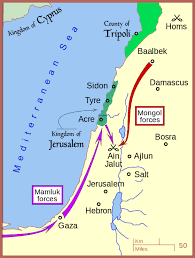
In January 1260, as the Mongols moved westward, Aleppo, Syria, met the same fate as Baghdad. In March, Damascus opened its gates to the Mongols and surrendered. Shortly afterward, the Mongols took the Palestinian cities of Nablus and Gaza.
Hülegü, the Mongol general, demanded that Sultan al-Muzaffar Sayf al-Din Qutuz, the Muslim ruler of Egypt, also yield to them. Hülegü threatened that if he did not, Egypt would suffer dire consequences. Hülegü’s forces outnumbered the Egyptian army of 20,000 by some 15 to 1. “The Muslim world stood face to face with extinction,” says Professor Nazeer Ahmed, a historian of Islam. What was Sultan Qutuz to do?
Qutuz and the Mamluks
Qutuz was a Mamluk, a slave of Turkish origin. The Mamluks had served as soldier-slaves for the Ayyubid sultans of Cairo, Egypt. In 1250, however, those slaves overthrew their masters and became the rulers of Egypt. Qutuz, himself a former soldier-slave, subsequently seized power and became sultan in 1259. He was a skilled warrior who was not about to give up without a fight. His prospects for defeating the Mongols, however, seemed bleak. But then began a series of events that would shape history.
Word reached Hülegü that Möngke, the Mongol great khan, had died in distant Mongolia. Foreseeing a power struggle back home, Hülegü withdrew with most of his army. He left behind between 10,000 and 20,000 troops—sufficient, he thought, to complete the conquest of Egypt. Qutuz now perceived that the tide had turned in his favor. He determined that if he was to defeat the invaders, this was his opportunity to do so.
Lying between Egypt and the Mongols, however, was another enemy of the Muslims—the crusader forces that had come to Palestine to claim the “Holy Land” for Christendom. From them, Qutuz sought safe passage and the right to buy supplies in order to engage the Mongols in war in Palestine. The crusaders consented. Qutuz, after all, was the only hope the crusaders had of ridding the area of the Mongols, who were as much of a worry to them as they were to the Muslims.
Related


As a result, the stage was set for a decisive clash between the Mamluks and the Mongols.
Ain Jalut in Palestine
The armies of the Mamluks and the Mongols met in September 1260 (Ramadhan 658 AH) at Ain Jalut.
Historian Rashid al-Din says that the Mamluks drew the Mongols into an ambush at Ain Jalut. Qutuz hid most of his cavalry in the hills around the plain and ordered a small force forward in order to provoke a Mongol attack. The Mongols believed that they had the whole Mamluk army before them, so they charged. Qutuz then sprang his trap. He ordered reserve units to gallop out of their hiding places and attack the Mongol flanks. The invaders were defeated.
This was the first Mongol defeat since they had launched their westward thrust out of Mongolia 43 years earlier. Though the number of troops involved was relatively small, Ain Jalut is considered to be one of history’s most significant battles. It spared Muslims from annihilation, broke the perception of Mongol invincibility, and allowed the Mamluk army to retake lost territories.
Ain Jalut’s Aftermath
The Mongols returned to the area of Syria and Palestine a number of times, but never again could they threaten Egypt. Hülegü’s descendants settled in Persia, converted to Islam, and in time became patrons of Islamic culture. Their territories came to be known as the Persian ilkhanate, that is, “subordinate khanate.”
Qutuz did not enjoy his victory for long. He was killed by his rivals shortly afterward. Among such rivals was Baybars I, the first sultan of a reunited kingdom of Egypt and Syria. Many considered him the ruler who was the real founder of the Mamluk regime. His new state—well-run and wealthy—lasted two and a half centuries, until 1517.
During that period of approximately 250 years, the Mamluks ousted the crusaders from the Holy Land, encouraged trade and industry, patronized the arts, and built hospitals, mosques, and schools. Under their rule, Egypt became the unrivaled center of the Muslim world.
The battle of Ain Jalut affected more than the Middle East. It also set the course of Western civilization. Had the Mongols succeeded in conquering Egypt, they might have been able, following the return of Hülegü, to carry on across North Africa to the Straits of Gibraltar. Since, in the meantime, the Mongols had also reached Poland, they would have held Europe in a giant pincer.
Under such circumstances, perhaps the European Renaissance would never have occurred. The world today might have been a considerably different place.