Teachers express concerns over Religious Studies in CBE curriculum
Religious education teachers said the present structure could derail the ambitions of students who desire to incorporate religious studies in their fields of study and could potentially undermine spiritual growth among young minds as well as affect the employment of teachers of religious education.
Concerns have been raised that the new Competency-Based Education (CBE) curriculum will limit the aspirations of students wishing to take up religious education at the Senior School level.
Religious education teachers from various secondary schools in the country said that while they appreciated the efforts by the government to strengthen the country’s education system, the present structure could derail the ambitions of students who desire to incorporate religious studies in their fields of study and could potentially undermine spiritual growth among young minds as well as affect the employment of teachers of religious education.
In a letter addressed to the director of the Kenya Institute of Curriculum Development (KICD) and the Kenya National Examination Council (KNEC), the teachers emphasized that there was a need to review the present structure to ensure that religious education continues to instill spiritual values among learners.
They specifically pointed out that learners who wish to pursue all three sciences (physics, chemistry, and biology) at the senior school level may be denied the opportunity to formally study Islamic Religious Education (IRE), Christian Religious Education (CRE), or Hindu Religious (HRE), despite the subjects’ significance in shaping their character, discipline, and moral values.
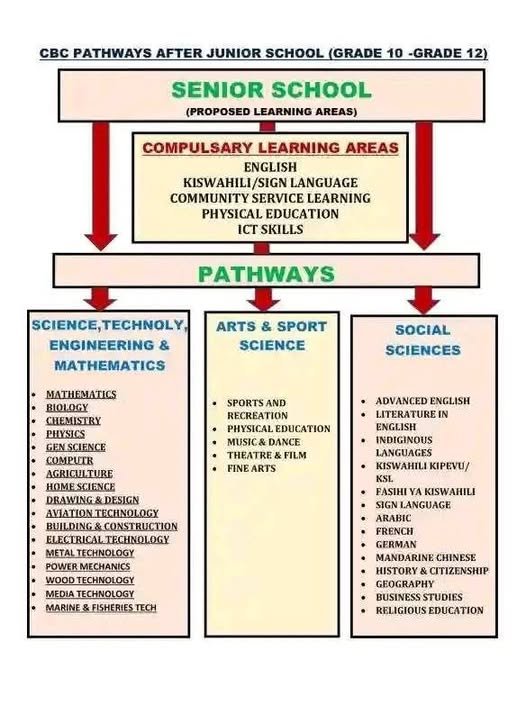
The new curriculum introduced three pathways, namely, Science, Technology, Engineering, and Mathematics (STEM), Social Sciences and Arts and Sports Sciences.Under the present structure, each student is limited to take seven learning areas that align with their chosen pathway. In the new education setup, religious education subjects are grouped under social sciences.
“This reduction restricts opportunities for the inclusion of religious education subjects, which play a central role in promoting moral values, ethical conduct, and spiritual development — key components of holistic education envisioned in the CBC framework,” said the letter dated November 10, 2025.
In contrast to the former 8-4-4 curriculum, students at the secondary school level were required to take a minimum of seven and a maximum of eight examinable subjects, which allowed flexibility to include other subjects such as religious education, ensuring that learners received both academic and moral guidance.
While many faith-based schools are likely to offer the STEM pathway to meet learners’ academic aspirations and societal demands, learners who wish to pursue all three sciences (Physics, Chemistry, and Biology) may be unable to include IRE/CRE/HRE within their seven-subject limit. For faith-based schools whose mission emphasizes nurturing both academic excellence and spiritual growth, the limitation will pose a challenge to providing formal religious education to the learners who desire to embrace the STEM pathway.
In addition, with fewer choices for students offering religious studies occasioned by the limited seven learning areas, the new structure also poses a threat to the employment and professional relevance of religious education teachers, many of whom, especially IRE tutors, are already facing unemployment or underemployment. “This situation will worsen, leading to even more teachers losing their jobs, as will be seen majorly in private schools,” the communique from the teachers said.
“This decline in the teaching and uptake of religious education will eventually affect universities and teacher training institutions. Courses related to religious studies may experience drastically reduced enrollment, diminishing their significance and threatening the sustainability of these programs in the long run. This would be a major setback to Kenya’s education system, which has historically valued moral and spiritual education as an integral part of national development,” the letter added.

In their proposal, the teachers called on KICD and KNEC to reconsider and revise the current limitation of seven learning areas, where the schools are granted the flexibility to offer up to eight learning areas, as was the case under the 8-4-4 system. “The eighth subject may be considered optional or non-graded among the seven core subjects. This flexibility will enable faith-based schools to continue offering IRE, CRE, or HRE, while still allowing learners to fully pursue their chosen academic pathways (STEM, Social Sciences, or Arts and Sports Sciences),” said the communique.
While the education ministry issued a directive to schools to ensure that pastoral/religious programmes are incorporated in the new curriculum, the teachers say that this is not adequate for students wishing to continue formal religious studies through the STEM path.
Expressing concerns on the developments, Mombasa-based scholar Sheikh Reshard Ramadhan said the present structure risks producing students lacking Islamic values. “With the present structure, we may have schools producing engineers, doctors and other professionals who lack Islamic values,” he told Sahifa Media.
The scholar called on the Muslim Education Council (MEC) and other stakeholders to explore ways of addressing this matter and ensure that students who yearn to continue pursuing Islamic education regardless of their pathways at the Senior School are not denied their inalienable right.