
How a once forgotten highway is going to reshape Northern Kenya
The road from Isiolo to Modogashe is nearing completion, a transformation that anyone who has travelled that stretch can now see. Sections between Wajir and Elwak are advancing steadily

By Mohamed Guleid
In a small café in Wajir, Fatuma recalls the moment she stopped believing that a proper road would ever reach her town. It was in 2019, at the peak of the dry season. She was riding atop a lorry transporting goats to Nairobi, the country’s largest market for meat. Barely three hours into what should have been a 36 hour journey, the road simply vanished, washed away by flash floods, leaving behind gullies and broken ground. The driver turned back. They spent two days stranded. The animals weakened, their value dropped, and the buyer moved on. That day, Fatuma lost money, but more importantly, she lost faith.
“Good roads were stories from other places,” she told me recently, seated under a slow moving fan.
Today, that story has changed. Her phone buzzed a few days ago with news that carries far more certainty than past promises. The World Bank has approved new and additional financing to complete the remaining sections of the Isiolo to Mandera corridor. For the first time, every stretch of the 740 kilometre road, from Isiolo all the way to Mandera, is now fully financed. The long missing links between Modogashe and Samatar, and between Rhamu and Mandera, are no longer gaps in a plan. They are part of a funded and deliverable reality.
What makes this moment different is not just the financing. It is the progress already visible on the ground. The road from Isiolo to Modogashe is nearing completion, a transformation that anyone who has travelled that stretch can now see. Sections between Wajir and Elwak are advancing steadily, with works progressing and momentum building. This is no longer a distant vision. It is a corridor under construction, taking shape in real time.
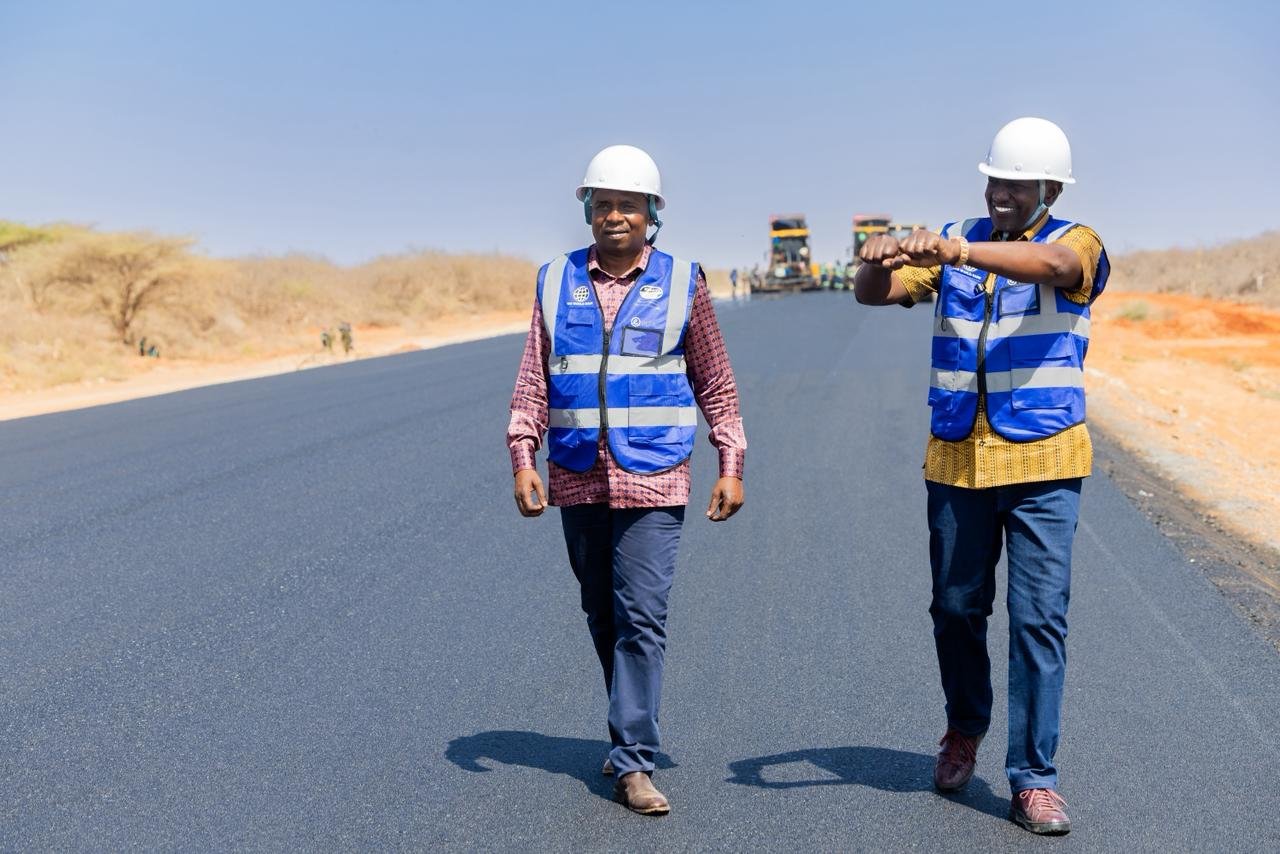
President William Ruto and his deputy Kithure Kindiki on an inspection tour of the Isiolo-Mandera Highway
I wrote about this road nearly a decade ago, describing it as a corridor of neglect, a powerful idea undermined by fragmentation. Northern Kenya was physically part of the country, yet economically distant from it. Roads faded into dust and markets remained disconnected. Communities were separated not by geography, but by the absence of deliberate investment. That gap was never just about infrastructure. It was about fairness, about whether all Kenyans truly shared in the promise of the nation.
Today, that gap is being closed, deliberately and decisively. With the new financing, the World Bank is now supporting nearly 80 percent of the corridor. More importantly, its role goes beyond financing. The Bank will closely support implementation, ensuring strong monitoring, reinforcing quality control, and tracking progress throughout delivery. This level of engagement brings confidence that the road will not only be built, but built well and completed.
For communities across Northern Kenya, this is already translating into tangible change. A livestock trader in Wajir can now plan for faster and more reliable access to markets. A student in Garissa can think in hours instead of days when travelling to school. Traders can move goods with predictability, reducing costs and expanding opportunity. What was once uncertain is becoming structured. What once felt distant is becoming reachable.
But roads in this region have always meant more than movement. They represent recognition. For years, Northern Kenya has been framed in terms of its challenges, drought, insecurity, and marginalization, rather than its potential. This corridor signals a shift. It affirms that the region is not peripheral, but central to Kenya’s future.
The transformation goes beyond the road itself. Fibre optic cables are being laid alongside the corridor, connecting communities to the digital economy. Investments in water, healthcare and education are being integrated along the route, ensuring that development is felt beyond the tarmac. The design incorporates climate resilience, recognizing the realities of drought and flooding in the region. This is infrastructure built not just for today, but for generations.
The corridor is also reshaping Kenya’s regional outlook. By strengthening connectivity, it deepens economic ties with Ethiopia and Somalia. Border towns that once felt remote are becoming gateways, centres of trade, movement and exchange. Geography is no longer a barrier. It is becoming an advantage.
Fatuma is already thinking differently. Her plans are modest, but meaningful. Expanding her trade, reaching new markets, moving goods more efficiently. “It is not just the road,” she told me. “It is what the road makes possible.”
She paused, then added quietly, “It means we are finally part of the story.”
The Isiolo to Mandera corridor has always carried a deeper meaning. It is a test of whether Kenya can truly integrate its northern frontier, whether distance and neglect can give way to connection and opportunity. With every section now financed, and with construction steadily advancing, that test is being answered. For Northern Kenya, this is no longer a promise waiting to be fulfilled. It is a transformation already underway.
And for the first time, the road home is certain.
The Writer is the Former Deputy Governor of Isiolo County
Former CEO of the Frontier Counties Development Council (FCDC)