
Goats prices fall to Sh1,000 as drought bites in Mandera
More than 25,000 livestock have died in the region this month alone due to hunger, thirst, and disease.
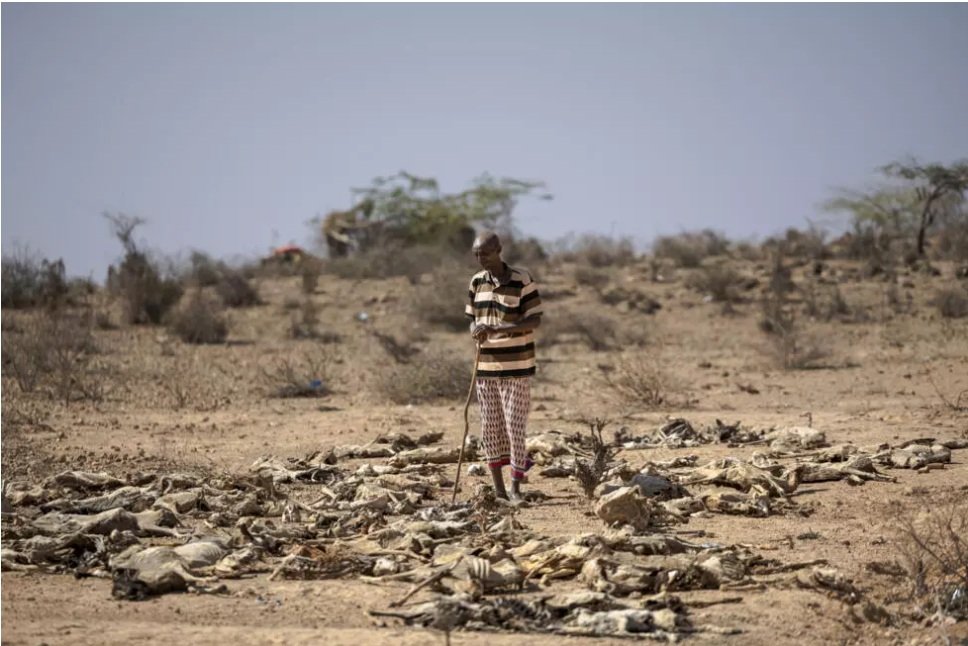
Livestock prices in drought-stricken parts of northern Kenya have plummeted to unprecedented lows, dealing a devastating blow to pastoralist communities whose livelihoods depend almost entirely on animals. In Mandera County, goats that once fetched up to Sh15,000 are now being sold for as little as Sh1,000 as desperate herders rush to offload weakened animals before they succumb to starvation.
The sharp decline in prices is directly linked to the ongoing severe drought, which has depleted pasture and dried up critical water sources across the region. The drought, caused by the failure of three consecutive rainy seasons, has left herders with little choice but to sell off their livestock at throwaway prices to avoid total losses.
According to local officials, more than 25,000 livestock have died in the region this month alone due to hunger, thirst, and disease. The mass deaths underscore the deepening humanitarian crisis in arid and semi-arid areas, where communities are struggling to cope with increasingly frequent and severe climate-related shocks.
Livestock remains the backbone of the economy in Kenya’s North Eastern region, with most households relying on cattle, goats, sheep, and camels for food, income, and overall survival. The loss of animals, coupled with the drastic fall in market prices, has therefore dealt a severe economic blow to thousands of families, pushing many closer to poverty.
Prolonged dry conditions have forced herders to trek long distances in search of water and pasture for their livestock, further weakening their health and reducing productivity. Many of the animals brought to market are visibly emaciated, discouraging traders and further depressing prices.
“Before the drought, a single goat could fetch up to Sh15,000. Now I am forced to sell them for as little as Sh1,000 to avoid losing them completely to starvation and disease,” said Abdullahi Mohamed, a livestock trader in Mandera.
The drought has also severely affected milk production, a critical source of nutrition for pastoral households. Average household milk consumption has dropped to about half a litre per day, compared to nearly four litres before the drought. “Our animals can no longer produce milk like before because they walk very far to find water and pasture,” said Osman Gabow, a resident of Mandera North. “Some days, there is almost no milk at all for our families.”
Local leaders and humanitarian agencies have warned that unless urgent interventions are implemented, continued livestock losses could deepen poverty levels, worsen malnutrition, and threaten the survival of pastoral communities across the region. “The current situation in Mandera is at an alarm phase and urgent humanitarian intervention is needed,” said Mustafa Adan, an official with the Kenya Red Cross in Mandera.
At Banissa’s main hospital, an influx of severely malnourished children has overwhelmed the paediatric ward. “Children are not getting an adequate diet because of this drought...they depend on camel and goat milk but there is now no milk at all,” said hospital nutritionist Khalid Ahmed Wethow.