
Allow Islamic law to function within country’s legal system-Supreme Court nominee Judge Warsame
Judge Mohammed Warsame asserted application of Islamic law within the country’s legal system would complement the dispensation of justice.
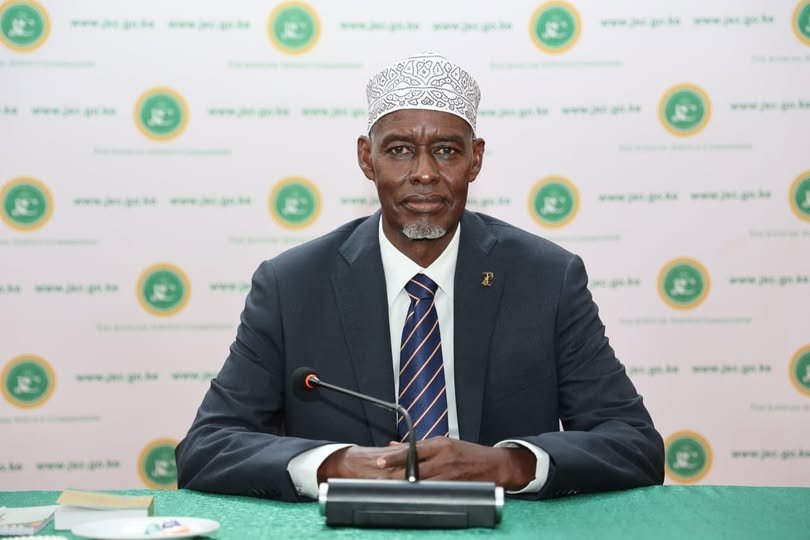
Allow Islamic law to function within country’s legal system-Supreme Court nominee Judge Warsame
The application of Islamic law should be allowed to function within the parameters of the Constitution.
Court of Appeal Judge Mohammed Warsame asserted that Islamic law is not merely a set of cultural rules, and that its application within the country’s legal system would complement the dispensation of justice.
Warsame, who was nominated on Wednesday, April 30, as a Judge of the Supreme Court of Kenya by the Judicial Service Commission (JSC), called for the protection of limited religious legal space. He emphasized that multiple legal systems can coexist within the constitutional framework, noting that religious law, as embedded in the Kadhi courts, can align with constitutional principles in the country’s secular system.
“We should not constitutionalise Islamic Sharia, but allow it to operate within the parameters of equality and fairness. Islamic law is not repugnant to justice,” he said during the JSC interview for the position of Supreme Court judge.
During the interview, he explained that on matters of inheritance, Islamic law is just and fair, adding that the Shariah is a legal system that provides for all scenarios.
“Islamic law of inheritance is fundamentally just and fair. Anybody who departs from these principles is not acting within the tenets of the religion,” he said.
Revisiting a Supreme Court judgment that granted inheritance rights to children born out of wedlock in an Islamic marriage, Judge Warsame noted that while the court based its decision on the Constitution, the ruling adversely affected the parties involved and the broader Muslim community.
“There was a way to resolve this issue under Islamic Shariah if the matter had been left to the Kadhi courts,” he said.
The nomination followed a rigorous recruitment process to fill a vacancy that arose after the death of the late Justice Mohammed Kadhar Ibrahim in December.
Announcing the decision, the Commission described Justice Warsame as “a founding member of this Court, a pioneer, and a jurist of rare integrity whose dedication to constitutionalism and access to justice set an enduring standard for all who serve not only on Kenya's highest bench but across all courts,” said Chief Justice Martha Koome, who also chairs the Judicial Service Commission.
The statement added that the judge had demonstrated the qualities required of a Supreme Court justice, earning the Commission’s confidence for appointment to the country’s highest court.
The nomination will be transmitted to the President for formal appointment, as outlined in the Constitution. His appointment will ensure continued Muslim representation on the apex court following the death of Mohamed Kadhar Ibrahim.
Five candidates were interviewed over a two day period, including Court of Appeal Judge Katwa Kigen, former Independent Policing Oversight Authority chairperson (IPOA) Anne Makori, and High Court judge Joseph Sergon, as well as Court of Appeal judge Francis Tuiyott and Mohammed Warsame.
Before his latest elevation to the apex court, Judge Warsame had served at the Court of Appeal since 2012.
Prior to his appointment to the Court of Appeal, he served as a High Court Judge in the Commercial Division, Criminal Division and was also in charge of the Judicial Review Division of the High Court.
Before his appointment to the High Court in 2003, he was a practising advocate of the High Court of Kenya. In 2013, he was elected as a Commissioner to the JSC by Court of Appeal judges.
Justice Warsame has maintained an impressive record in case clearance rates. As the Chairman of the Community Service and Probation Committee, he released over 7,000 petty offenders from prisons all over the country.