
A Life of Faith and Service: Ahmed Mohamed Khalif, Kenya’s shortest serving Cabinet Minister
His political life was defined by principle, courage, and unwavering advocacy for Muslims and the Somali community in Kenya
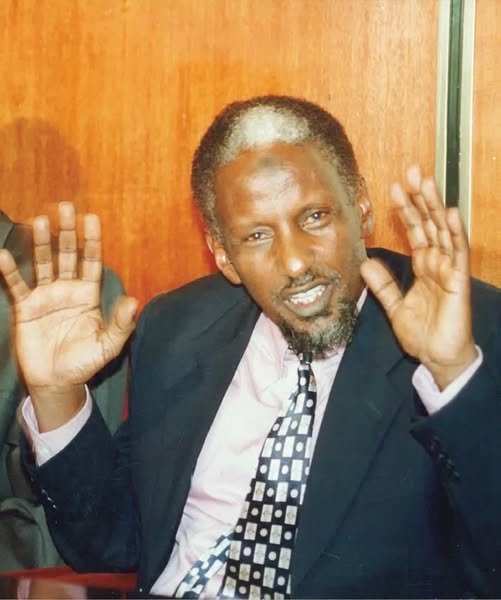
He served for just 20 days as a Cabinet minister—the shortest tenure in Kenya’s history. Yet in that brief span, Ahmed Mohamed Khalif etched his name indelibly into the country’s political memory.
Appointed in early 2003 by President Mwai Kibaki as Minister for Labour and Manpower Development, Ahmed became the sole Cabinet minister from the wider North Eastern region in Kibaki’s administration—a moment of profound symbolic inclusion for a region long relegated to the margins of national power.
That promise was cut short on 24 January 2003, when the newly appointed cabinet minister died in a tragic plane crash while returning from a homecoming ceremony in Busia for Moody Awori, then the newly elected Member of Parliament for Funyula, who would later serve as Kenya’s Vice President.
Moments before boarding the Gulfstream jet, Khalif had delayed his colleagues, stepping into a nearby mosque to pray. It would be his final act.
Shortly after take-off, the aircraft struck power lines, lost control and crashed into a residential estate. He succumbed to his injuries shortly after being rushed to hospital, alongside the two pilots who also perished. Several other passengers survived with injuries, among them Cabinet ministers Martha Karua, Raphael Tuju, and Jebii Kilimo, as well as Martha Koome—now Kenya’s Chief Justice—and George Khaniri, a former Kakamega senator.
His death brought an abrupt end to a political life defined by principle, courage, and unwavering advocacy for Muslims and the Somali community in Kenya.
Before joining the Cabinet, Ahmed had served as Secretary General of the Supreme Council of Kenya Muslims (SUPKEM), where his voice was both persistent and unyielding in demanding respect, equality, and protection of Muslim rights. He emerged as one of the most articulate Muslim leaders, engaging the state on Muslim concerns.
He was also a media pioneer, playing a central role in establishing the Iqra Broadcasting Network, the country’s first Islamic radio station. Broadcasting from Bandari Plaza in Westlands, Iqra FM became a 24-hour platform dedicated to uplifting Muslim voices, faith, and perspectives at a time when such representation was virtually non-existent.
Born in 1950, Ahmed Khalif came from a family steeped in public service. His father was a police inspector who later rose to become a chief, while his elder brother, Abdirashid Khalif, represented the Northern Frontier District at the historic Lancaster House constitutional talks in the early 1960s.
A journalist by training and an alumnus of the University of Nairobi, Khalif worked both as a government information officer and with the British Broadcasting Corporation (BBC) before entering elective politics.
He joined active politics serving as the Wajir West MP from 1979 to 1997 when he lost the seat to Adan Keynan, then a candidate for Safina Party candidate.
During the Wajir Massacre of February 1984, when security forces carried out a brutal operation targeting members of the Degodia community, Ahmed Khalif—then the area MP—stood in Parliament to table the names of the victims and unequivocally condemn the killings. His bravery in confronting state violence earned him heroic status among Somali communities across the country.
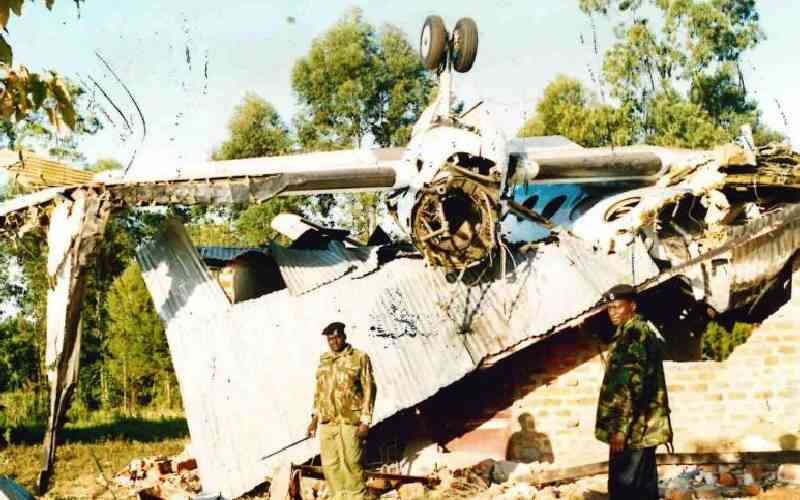
The Gulf Stream jet which killed the Cabinet Minister
He was equally resolute in opposing the government’s policy requiring Kenyan Somalis to the carry special “pink cards”, a discriminatory measure ostensibly meant to distinguish citizens from Somalia nationals. He enlisted prominent lawyer Mohamed Ibrahim—later a Supreme Court judge—to challenge the policy in court. The successful case further cemented his reputation as a fearless defender of Somali citizenship and dignity. Mohammed Ibrahim passed away on 17 December last year.
As the 2002 general elections approached, Khalif threw himself into the Ufungamano Initiative, a civil society movement pressing for comprehensive constitutional reform. He later joined the National Rainbow Coalition (NARC), the broad alliance determined to end KANU’s decades-long rule.
NARC’s landslide victory swept Ahmed back into Parliament as Wajir West MP, defeating Adan Keynan. In recognition of his pivotal role in mobilising support for NARC across North Eastern Province, President Kibaki appointed him to the Cabinet—an appointment that carried both political and historical weight.
A deeply principled leader, Ahmed’s public life was inseparable from his faith and his sense of moral responsibility. He was remembered as a bridge-builder—between communities, between faith and state, and between Kenya’s periphery and its centre of power.
Following his death, a by-election was held in which his son, Mohammed Khalif, then just 23 years old, was elected Member of Parliament and later appointed Assistant Minister, continuing the family’s tradition of public service.
May Allah forgive his shortcomings, accept his deeds, and grant him Jannatul Firdaws among the righteous.